


Govern your AI representation.
Prove it with evidence.
The enterprise AI governance platform to certify, audit, and defend brand representation at scale.
more likely to achieve effective AI governance with a purpose-built platform vs. legacy GRC tools¹
of the world’s economies will be subject to fragmented AI regulation by 2030²
boost in AI security and governance controls by 2030, driven by insurer-mandated AI risk requirements³
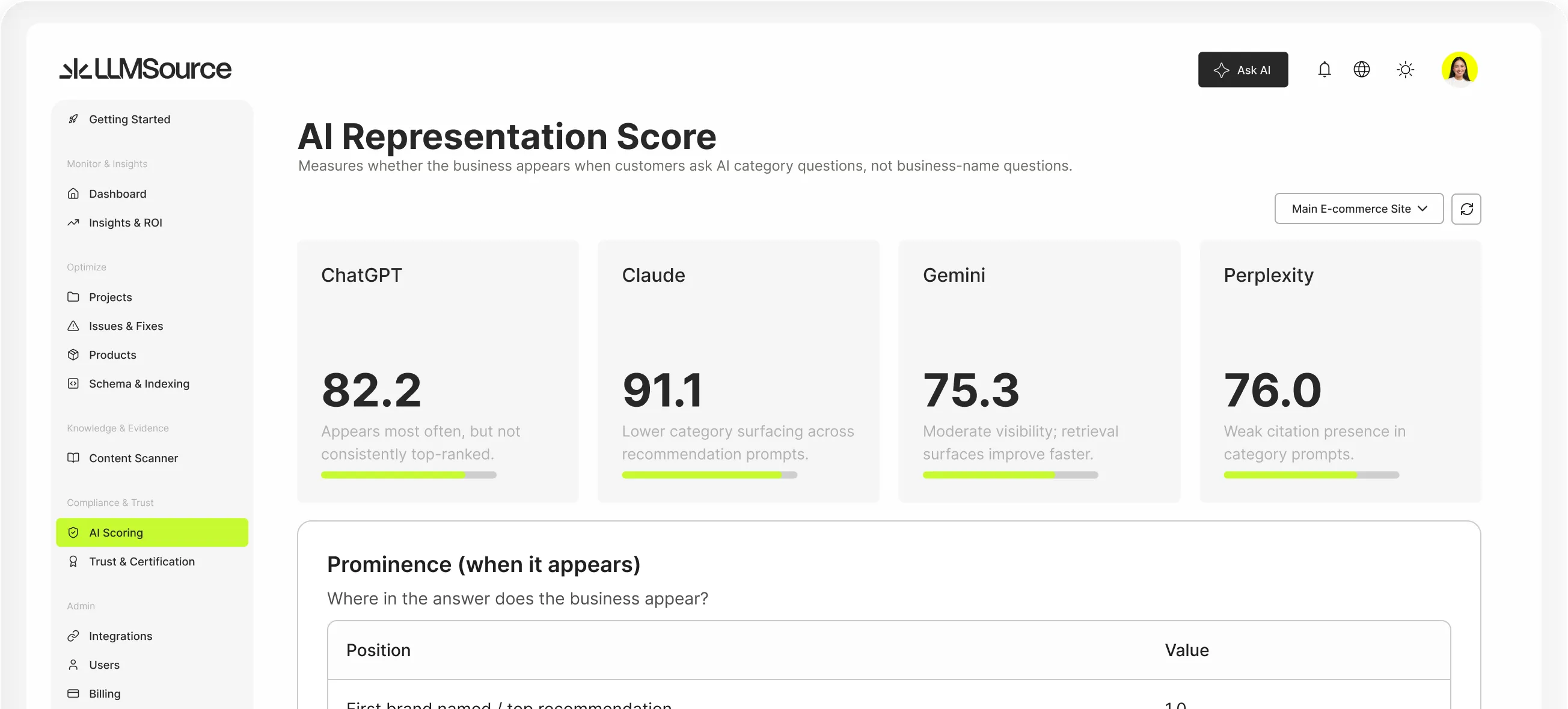
A single platform built for governance, not guesswork

Establish your brand’s AI-trustworthiness
- Earn the badge with a unified score that combines your AI Quality Score (AQS), AI Trust Score (ATS), and AI Representation Score (ARS) into one clear signal
- Show AI systems your brand clears the bar for accurate, high-visibility content, and is worth recommending
- Stay current with the badge’s ‘live’ status, allowing you to respond swiftly if something slips

How an enterprise deployment runs
Brief your leadership
We’ll brief your CISO, CCO, and brand lead on your AI representation risk and the governance controls each role will use.
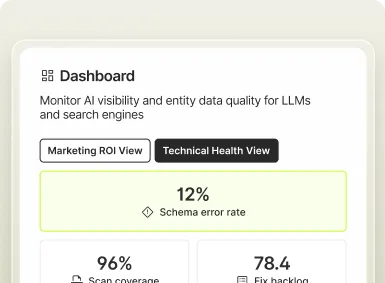
Run pilot and certify one entity
Deploy one entity with the Control layer, SSO, and SCIM live. Run your first certification cycle and SOC 2 export, then validate before rollout.
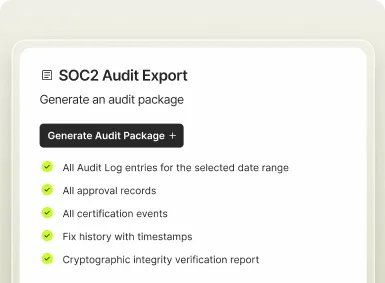
Roll out and govern
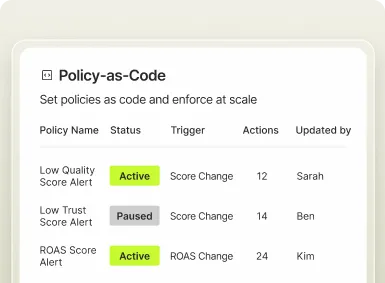
Expand to brands, subsidiaries, and regions. Turn on policy-as-code rules and build a quarterly governance review into the cadence.



Scoped to your committee.
Priced around your scale.
Scoped around entity count, data residency, SLA, and governance depth — you get a quote, audit sample, and a 45-minute briefing, NDA-ready.
Common questions
AI governance platforms govern how your organization uses AI internally: model inventory, runtime policy enforcement, internal bias controls. LLMSource Enterprise governs how AI systems represent your business externally: discoverability, trust, certification, and the audit trail to defend that record.
Rules are defined in code with triggers (event types like Scan Complete or Score Change), conditions (thresholds, patterns, time windows), and actions (notify, escalate, block, require approval). Rules can be tested against historical events before activation. Two-person rule applies to designated critical changes, requiring sign-off from two authorized roles within a configurable window.
Each entity submits to a pre-certification checklist covering claim verification, evidence backing, schema completeness, and AI Trust Score thresholds. A Bronze, Silver, or Gold badge is issued, cryptographically signed with Ed25519, and given a public verification URL. Renewal warnings fire at 90, 60, 30, and 7 days. Certification scope is configurable per entity.
LLMSource is SOC 2 Type II certified across all tiers. Enterprise adds mandatory SSO (SAML 2.0, OIDC), automatic SCIM 2.0 provisioning, AES-256-GCM per-tenant encryption with key versioning, pattern-based PII and DLP detection, IP allowlisting with emergency override, and data residency selectable per entity across EU, US, and APAC regions.
Yes. Per-tenant AES-256-GCM encryption supports customer-managed keys via your KMS (AWS KMS, Azure Key Vault, Google Cloud KMS). Key rotation is automated on a configurable schedule. If your security team requires hardware security module backing, HSM-backed key generation is available with custom rotation policies and quarterly key audits.
Enterprise audit logs are retained for three years by default, with cryptographic integrity verification on every entry. Longer retention is available on request, including indefinite archival for regulated industries. The log is immutable and cannot be deleted by any user, including Admins. SOC 2 PDF export is one click; raw JSON export is available via API.
Yes. Multi-entity governance with parent and child structure, aggregate visibility across the holding company, and per-entity data residency. One contract, one platform, jurisdiction-compliant deployment everywhere. Bronze, Silver, and Gold certification can be issued per entity, with renewal lifecycle tracked centrally.
The standard offering is multi-tenant SaaS with per-tenant encryption and data residency selection. Single-tenant deployment in a dedicated cloud environment is available on Enterprise contracts above a usage threshold. Fully on-premise or air-gapped deployment is custom engineered and typically scopes 90 to 120 days. Talk to sales for a feasibility assessment.
Enterprise contracts include a mutually negotiated MSA, customer-specific DPA, and indemnification for IP, data security, and platform availability. Standard terms include 99.9% uptime SLA with credits, defined liability caps, and breach notification within 72 hours. Custom terms (extended indemnification, higher liability caps, custom SLAs) are negotiated case by case.
Every Enterprise contract includes a named CSM with a quarterly business review cadence, custom governance playbook, and direct access to engineering for escalations. Onboarding is white-glove: a six-week pilot with one entity, governance committee briefings, and pre-certification support. Priority support runs at a one-hour SLA for critical issues, 24/7.
Native integrations cover Slack, Microsoft Teams, and Google Chat (communication); Zendesk, Jira, and ServiceNow (ticketing, priced per platform); and Contentful, Adobe Experience Manager, and Sitecore (CMS/DXP) are included at Enterprise. SSO/SCIM is available in the Enterprise plan, while Business plans get SSO capabilities as an add-on. For anything else, let us know as we can scope custom integrations through our Custom Connector SDK.